

Abstract of EVO ICL Surgery
Eye corrective surgery has also improved significantly over the last several decades, providing individuals with more efficient and durable ways to correct refractive defects. EVO ICL Surgery is one of these developments that is very safe and effective as an alternative to laser surgeries. In this technique, a special collamer lens is implanted inside the eye, enhancing vision without altering the cornea. It is particularly helpful to people with high myopia, thin corneas or to individuals who are not good candidates for LASIK.
This paper describes EVO ICL surgery in detail by discussing its mechanism, procedure, advantages, potential risks, and recovery. It also briefly mentions the associated eye and cosmetic operations, i.e., blepharoplasty, Selective Laser Trabeculoplasty and Almond Eye Surgery to provide the readers with a wider scope on the modern eye operation. The article focuses on eligibility, post surgery treatment and the future of refractive surgery technology.
Introduction to EVO ICL Surgery
One of our most valuable senses is the sense of vision. It allows us to be in touch with the environment and to perform daily duties effectively. However, it is unfortunate that most individuals have refractive defects such as myopia, hyperopia, and astigmatism that prevent the eye from focusing the light on the retina properly. Conventional interventions, such as glasses or contact lenses, are effective but are inconvenient or uncomfortable to be used on a long-term basis.
In order to deal with these obstacles, ophthalmology has come up with permanent surgical means. The laser technology, LASIK and Photorefractive Keratectomy lasers, reshaped the cornea, and were popular in the late twentieth century.
They are not the same as those that can be used by everyone. Laser surgery may not be available to patients whose corneas are thin, who have severe prescriptions or who have some eye conditions. To this, new technologies such as EVO ICL surgery came into the picture to counter these shortcomings.
EVO ICL surgery is very safe, precise and reversible. A biocompatible lens is inserted in the eye rather than replacing the cornea, and the eye operates normally with this added component.
Conceptualising EVO ICL Surgery
What is EVO ICL Surgery?
EVO ICL is the short name of Implantable Collamer Lens. It is a flexible, soft lens that is inserted in the eye to rectify refractive errors. The lens is placed between the iris and the natural lens, which enhances the focus of light on the retina.
Collagen and polymer are fused together in the lens material, collamer. It is very biocompatible, and hence the body does not reject it with much immune response.
In contrast to the majority of refractive surgeries, which make a permanent change to the cornea, EVO ICL surgery is reversible. In case of necessity, the lens can be removed or replaced by an ophthalmic surgeon, which is an added layer of safety to the patient.
Significant EVO ICL Surgery Characteristics
| Feature | Description |
| Type of procedure | Implantable intraocular lens |
| Vision problems treated | Myopia and astigmatism |
| Surgical time | Approximately 20–30 minutes |
| Recovery period | 1–2 days for normal activities |
| Permanence | Long-term but removable |
| Suitability | Patients aged 21–45 with stable prescriptions |
Refractive Error medical interventions with EVO ICL
EVO ICL surgery also corrects a number of refractive errors, which impair the ability to see clearly.

Myopia (Short‑sightedness)
Myopia is a situation experienced when the eye is excessively long or has a too curved cornea. Light refracts before the retina, thus causing distant objects to blur, whereas the close objects remain clear.
EVO ICL surgery changes the focal point to place the light in the retina.
Astigmatism
Astigmatism is the irregular cornea or lens curvature, which may result in poor focus on the retina. It clouds or distorts the vision of every distance.
These irregularities are countered by specialised toric EVO ICL lenses, which restore the vision of the person.
Refractive Errors and their effects
| Condition | Cause | Symptoms |
| Myopia | Long eye ball | Blurred distant vision |
| Hyperopia | Short eyeball | This causes one difficulty in focusing on close objects |
| Astigmatism | Irregular corneal curvature | Distorted or blurred vision |
The EVO ICL Surgical Operation
The EVO ICL surgery is also less invasive and simple, and it is performed in an outpatient environment.
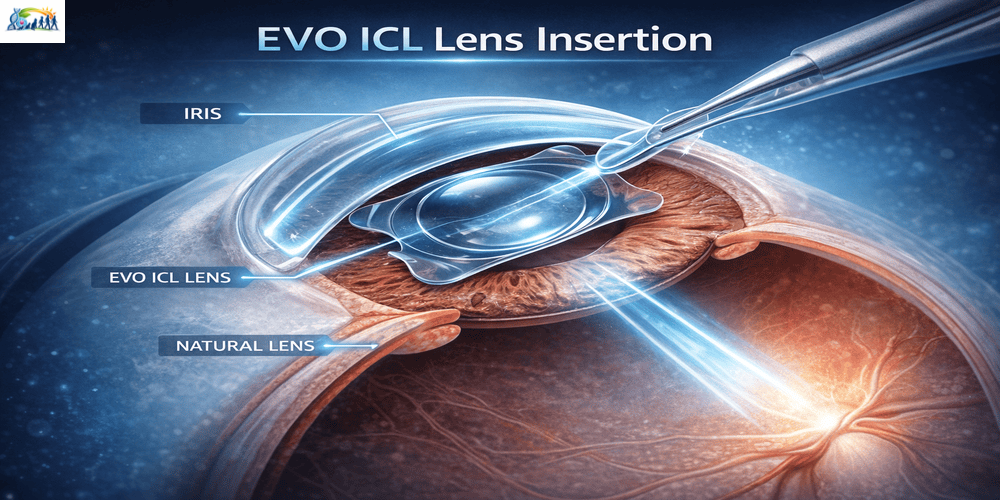
Step‑by‑Step Process
| Step | Description |
| Pre-operative assessment | Eye measurements and suitability tests |
| Anaesthesia | Numbing eye drops applied |
| Small incision | A tiny incision created in the cornea |
| Lens insertion | Folded lens inserted into the eye |
| Lens positioning | Surgeon positions lens behind the iris |
| Completion | Incision heals naturally without stitches |
It is performed in less than half an hour, and within a few moments of the surgery, most of the patients report that their vision improves.
The benefits of EVO ICL Surgery
The EvO ICL procedure has a number of advantages over the conventional laser surgery for vision statement.

Major Benefits
| Benefit | Explanation |
| High visual quality | Provides sharp and stable vision |
| Reversible | Lens can be removed if required |
| Corneal preservation | No removal of corneal tissue |
| UV protection | Lens blocks harmful ultraviolet rays |
| Rapid recovery | Patients resume normal activities quickly |
Night vision and glare are also improved with many of the laser procedures, which patients complain about.
Dangers and Probable Problems
EVO ICL surgery is not associated with many complications; however, the concurrent risk of complication can happen in uncommon cases.
Possible Risks
- Infection.
- Hikikomori eyes with heightened pressure.
- Cataract formation.
- Lens rotation (rare).
- Temporary glare or halos.
Such complications are rare and in many cases can be addressed successfully by medical treatment or by relatively simple corrective surgery.
Comparison of Other Vision Correction Procedures
Knowing about the distinctions between EVO ICL and other surgeries are capable of assisting patients in making their choices.
| Procedure | Method | Suitable For | Reversibility |
| EVO ICL | Implantable lens | High myopia, thin corneas | Yes |
| LASIK | Laser corneal reshaping | Mild to moderate myopia | No |
| PRK | Surface laser correction | Patients with thinner corneas | No |
| SMILE | Small incision laser surgery | Moderate myopia | No |
Although Lasik is still very popular, EVO ICL will be a great substitute for those who are not able to have laser surgery.
Before and after operations on the upper eye
Blepharoplasty also called upper eye surgery, is a cosmetic (and occasionally functional) surgery that removes excess skin, fat and muscle on the upper eyelids.
Purpose of Upper Eye Surgery
This is done both to be aesthetically beautiful and medically. Older individuals may experience skin on the eyelids that would appear wrinkled and droopy as a result of ageing, which may block out peripheral vision.
Typical Motivations behind Blepharoplasty
- Drooping eyelids.
- Excess skin around the eyes.
- Puffiness on account of fat deposits.
- Impaired peripheral vision.
Before and After Effects
Patients can have eyelids that are drooping and eyes that look excessive before surgery. The patients also tend to note:
- Improved eyelid contour.
- Reduced puffiness.
- Enhanced visual field.
- A younger appearance on the face.
Recovery Timeline
| Time Period | Changes |
| 1–3 days | Swelling and mild bruising |
| 1 week | Removal of stitches |
| 2 weeks | Significant cosmetic improvement |
| 1–2 months | Final results visible |
The cosmetic surgery most commonly practised in the world is blepharoplasty.
SLT Eye Surgery
Selective laser trabeculoplasty (SLT), which is a laser treatment, is another important ophthalmic treatment and is mostly used in the treatment of glaucoma.
What is Glaucoma?
Glaucoma is a category of eye diseases that affects the optic nerve as a result of high pressure in the eye. When glaucoma is not treated, it may cause irreparable loss of sight.
How SLT Works
SLT involves a specialised laser, which is directed to the drainage system of the eye, referred to as the trabecular meshwork. The laser activates cellular functions which enhance drainage of fluids and decrease intraocular pressure.
SLT Procedure Details
| Feature | Description |
| Treatment time | 5–10 minutes |
| Anaesthesia | Numbing eye drops |
| Hospital stay | Outpatient procedure |
| Recovery | Immediate |
SLT may also be advised when the control of eye pressure can only be achieved by glaucoma medications.
Almond Eye Surgery
Almond eye surgery is a cosmetic surgery that is performed to reshape the eyes to a slightly raised almond-like form.
Procedure Overview
This surgery is usually done in the form of lateral canthoplasty, which involves altering the outer corner of the eyelid.
Almond Eye Surgery Objectives
- Have a symmetrical eye shape.
- Lift drooping outer eyelids.
- To make one look younger or more beautiful.
Surgical Summary
| Feature | Details |
| Procedure type | Cosmetic |
| Surgery duration | 1–2 hours |
| Anaesthesia | Local or general |
| Recovery | 1–2 weeks |
The given procedure has become popular and is promoted by the changing standards of beauty and social media.
Eligibility of Candidates EVO ICL
Not any individual is a good candidate prevent EVO ICL surgery. You have to be examined by an ophthalmologist.
Ideal Candidate Criteria
| Requirement | Explanation |
| Age | Usually between 21–45 years |
| Stable prescription | No major changes for at least one year |
| Healthy eyes | No severe eye diseases |
| Refractive error range | Moderate to high myopia |
Other treatments might be required by people with some eye conditions.
Post-Operative Care and Recovery
The outcome of EVO ICL surgery is typically fast and safe, but the recovery process can only be optimal with the help of quality post-operative care.
Post‑Surgery Guidelines
- Take the medication of the antibiotic and anti-inflammatory eye drops when advised.
- Do not rub your eyes.
- Avoid swimming or exerting heavy exercise for a period of one week.
- Visit all of the follow-up appointments.
The majority of patients report having a clear vision in one to two days after surgery.
Long‑Term Outcomes
In clinics, EVO ICL has been found to provide good results in visual output in the long term. Most of the patients receive a vision of 20/20 or better, which significantly increases the quality of their lives.
The implanted lens is retained in the eye and does not require any maintenance, yet it is advisable to have regular eye cheques to cheque the general health of the eye.
Vision Correction Future Developments
Ophthalmic technology has also improved, in enhancing the visual-correction processes. Future developments will consist of:
- Artificial Intelligence-based preoperative surgery planning.
- Implantable lenses of the next generation.
- Better laser precision technologies.
- Lensar refractive surgery and laser refractive surgery.
The innovations are directed to enhance safety, improve the time of recovery and even better the results.
Short Questions and Answers about EVO ICL Surgery
1. What is EVO ICL surgery?
Ans: EVO ICL surgery is a vision correction procedure in which a soft, implantable collagen lens is placed inside the eye to correct refractive errors such as myopia and astigmatism without reshaping the cornea.
2. Is EVO ICL surgery safe?
Ans: Yes, EVO ICL surgery is considered very safe when performed by a qualified ophthalmic surgeon. The lens material is biocompatible and designed to work naturally with the eye.
3. How long does EVO ICL surgery take?
Ans: The procedure typically takes about 20–30 minutes, and it is performed as an outpatient surgery.
4. Is the EVO ICL lens permanent?
Ans: The lens is designed for long-term use, but it is removable and replaceable if necessary, which makes the procedure reversible.
5. Who is a good candidate for EVO ICL surgery?
Ans: Ideal candidates are individuals aged 21–45 years with stable vision prescriptions, moderate to severe myopia, and healthy eyes.
6. How soon can patients see clearly after surgery?
Ans: Most patients notice improved vision within 24 to 48 hours, although complete visual stabilisation may take a few weeks.
7. Does EVO ICL surgery hurt?
Ans: No, the surgery is generally painless because numbing eye drops are used during the procedure.
8. Can EVO ICL treat astigmatism?
Ans: Yes, specialised toric EVO ICL lenses are designed to correct astigmatism as well as myopia.
9. What are the possible side effects of EVO ICL surgery?
Ans: Some patients may experience temporary glare, halos, mild discomfort, or increased eye pressure, but serious complications are rare.
10. How is EVO ICL different from LASIK?
Ans: Unlike LASIK, EVO ICL does not reshape the cornea. Instead, a lens is implanted inside the eye, making it a better option for patients with thin corneas or high prescriptions.
Conclusion
EVO ICL surgery is possibly one of the advanced solutions to the requirements of refractive vision correction today. The operation enhances the level of vision by making use of a special type of collamer lens inserted in the eye, yet it does not change the cornea. It applies particularly well with individuals of high prescriptions or with thin corneas that do not qualify as good candidates of laser correction.
The surgery has a number of advantages, such as that it is reversible, it has a fast recovery, and it produces excellent vision outcomes. Although there are certain risks involved, it is safe to do so, as long as it is done by experienced surgeons.
EVO ICL is by no means the only eye operation; other eye treatments include blepharoplasty, SLT laser glaucoma, and almond eye surgery, which are some of the many modern eye operations designed to meet both functional and cosmetic requirements.
Since there is ongoing technological advancement, the vision-corrective surgeries are becoming safer, more accurate and more accessible. EVO ICL surgery can be another highly promising option in the modern eye care of those who are interested in an alternative to glasses or contact lenses, which has a long-term nature.